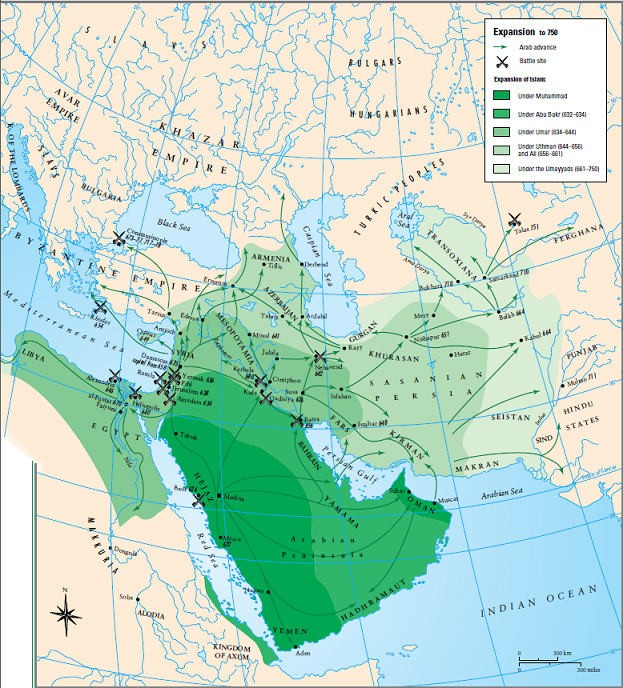
| Muhammad’s death left the Muslim community without an obvious leader. One of his oldest companions, Abu Bakr (r. 632–634), was acknowledged by several leaders as the first caliph, or successor. Under Abu Bakr and his successor Umar (634–644), the tribes, who had begun to fall away on the death of Muhammad, were reunited under the banner of Islam and converted into a formidable military and ideological force. The Arabs broke out of the peninsula, conquering half the Byzantine provinces as well as defeating the armies of Sasanian Persia. Ctesiphon, the Persian capital, fell in 637, Jerusalem in 638. By 646, under Umar’s successor Uthman (r. 644–656), the whole of Egypt had come under Arab Muslim control. Acquiring ships from Egypt and Syria, the Arabs conducted seaborne raids, conquering Cyprus in 649 and pillaging Rhodes in 654. Religious differences between the Byzantine rulers and their subjects in Egypt and Syria ensured that the Muslims were met with indifference, or even welcomed by fellow monotheists embittered by decades of alien Byzantine rule. But secular factors were also important. The Arabs were motivated by desire for plunder, as well as religious faith. In previous eras nomadic predators would have taken the plunder or held onto land, dispersing as landlords or peasants among the conquered peoples. In a farsighted decision Caliph Umar encouraged the tribes to settle with a system of stipends paid from the common treasury, which took control of the conquered lands. The Arabs were kept apart from the population in armed camps that evolved into garrison cities such as Basra and Kufa in Iraq. Although the tensions over the distribution of booty would erupt into open civil war the overall control exercised by the fledgling Islamic government remained under dynastic rule. Though individual dynasties would often be challenged as ruling contrary to Islamic principles of equality and justice, the dynastic system of governance fitted the prevailing form of social organization, the patriarchal kinship group, and remained the norm until modern times. Under the Umayyads the remarkable expansion of Islam continued, with the Arab raiders reaching as far as central France and the Indus Valley. |